Philosophers
and Poets
B38
| B39 | B40
| B42 | B56
| B57 | B81
| B104 | B105
| B106 | B108
| B121 | B129
Homer:
B42
| B56 | B105.Hesiod:
B40
| B57 | B106.Pythagoras:
B40
| B81 | B129
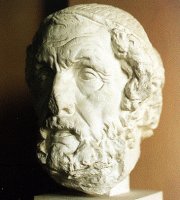
Bust
of Homer
|
What
did Heraclitus say about earlier philosophers?
Can
mythology tell us the truth about the world?
What
counts as knowledge?
|
|
|
Heraclitus spoke very negatively
about his predecessors. His major criticism is that his predecessors
were not able to recognize the underlying structure of the universe (see
cognition).
Many of them had learned quite a lot of facts, but were not able to really
see what Heraclitus himself saw. He criticized Homer for not being
able to answer a riddle that some boys asked him. Hesiod was attacked
for not recognizing that Day and Night are one: Hesiod thought that one
begot the other. Archilochus receives a harsh criticism, but with
no reason given. Xenophanes and Hecataeus are criticized for learning
many things without recognizing the underlying structure. Pythagoras
receives perhaps the harshest criticism. Heraclitus contrasts true
knowledge with the 'wisdom all his own' that Pythagoras made up (cf. B2),
calling it κακοτεχνίην,
'bad craft' (B129).
Only two people receive any praise:
Priene of Bias and Hermodorus. (Diogenes Laertius tells us that Heraclitus
said something about Thales, but it is unclear whether positive
or negative.)