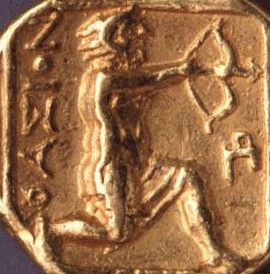
Heraclitus
carefully phrased his sayings so that he could exploit language and pack
as much information as possible in short and catchy sayings. He also
saw in language information about the nature of the universe. He
named his divine principle the λόγος
('word', 'spoken thing', 'account'). This λόγος
speaks to us in many different ways, but we must be able to understand
its language. Included above are fragments that rely on word play
or ambiguity to communicate their message. For example, in B48, Heraclitus
plays on the words
βιός
(the Homeric word for bow) and βίος
(life). As another example, Aristotle commented on B1 saying that
ἀεὶ
ambiguously
could modify eitherἐόντος
or
ἀξύνετοι
(Rhetoric
3.1407b11).
One of the ways the λόγος
speaks to us is through our own language: we must have wise souls that
understand what it is saying to us (see B107).